
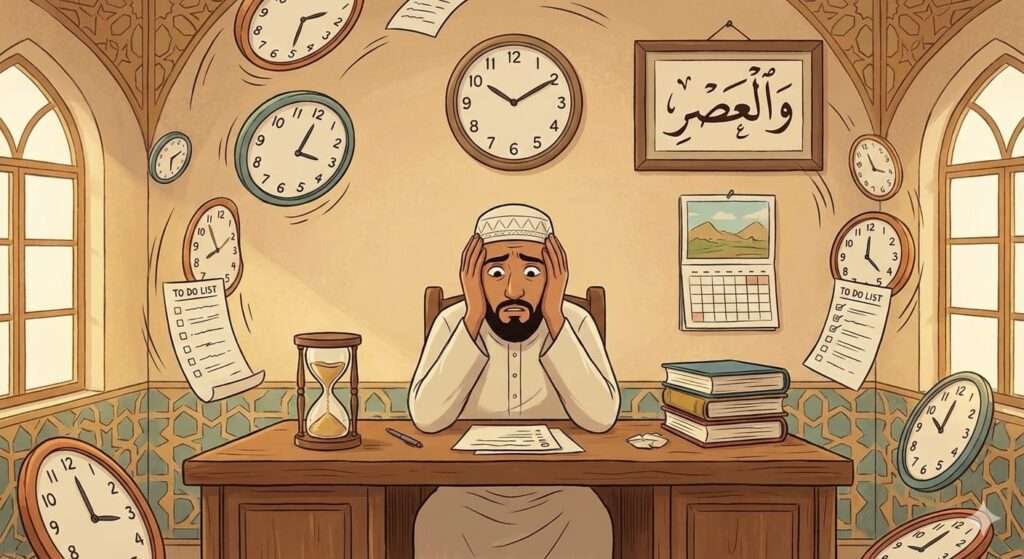
Time is such a blessing from Allah that once it slips from the hand, it becomes impossible to regain it. Allah has given a person a fixed and limited time in this world so that he may do good deeds, stay away from wrong actions, improve himself, and also be a source of goodness for others. If someone uses this precious time — from birth until death — in good and righteous deeds, then there can be no one more fortunate and truly successful than him.
But if we simply waste our time in worldly desires and distractions, then on the Day of Judgment we will have nothing except regret and sorrow. We must always remember that whatever blessings Allah has granted us are given as a trust and an amanah.
Our life and the time within it are also a trust from Allah, and tomorrow we will have to answer to Him about how we spent it. So come, let us reflect and understand how we can use our valuable time wisely in both Deen and dunya.
Why Time is Important
First of all, what we must understand is that whatever Allah has created in this world has been created with a purpose. Every single thing has its own value and importance. Nothing is created uselessly or without reason. Even if something does not directly relate to human beings, it is still valuable and serves another purpose in the system of creation. In the same way, time is also one of Allah’s greatest creations, and we exist within it.
We know that everything within time is limited. Only Allah is beyond time, and it is He who created time itself. Since time is a limitation for us, we must recognize its worth and appreciate its value. As much as possible, we should use it in good and beneficial deeds and avoid wasting it. If we fail to value what Allah has given us, then eventually we will face loss and regret.
A sinful person will wish on the Day of Judgment: “O Allah, grant me a little more time and send me back to the world so I may live a righteous life and worship You.” But Allah will say: “The time that was given to you was already fixed and sufficient.” Therefore, we should spend our time in meaningful pursuits — good actions, proper learning, and beneficial matters — and stay away from useless activities and places where there is neither worldly benefit nor benefit for Deen.
Avoiding Laziness
Secondly, an important point related to time that we must understand is that we should eliminate laziness from within ourselves. In today’s era, one of the biggest causes of wasting time is negligence and laziness. For hours and hours, we remain lying down scrolling on mobile phones, and we do not even realize how quickly and how much time has passed.
After wasting time, we feel regret that we have spent such precious moments on useless things. But regret alone changes nothing — lost time never returns. If we had protected it at the right moment and used it for valuable and productive work, perhaps we would not have to face disappointment later. Therefore, we must remove the habit of unnecessary sleeping and idle lying down, as laziness often grows from these behaviors.
If sleep comes at the wrong time, we should get up, sit properly, and engage in the remembrance of Allah. We should make daily exercise part of our routine, as it helps remove laziness. Likewise, food should be taken in moderation, because overeating also leads to sluggishness. Remember, once time slips from our hands and is wasted, nothing remains except regret. In the end, a person says: “If only I had worked hard on time… If only I had listened at the right time… I would have succeeded.”
Making a Daily Life Plan
Thirdly, among the important points, one key matter is how we can accomplish more work in less time and how we can save our time. The simplest and most effective way for this is to create a proper daily life routine and follow it consistently — this is what we call discipline. We have already discussed this topic in detail in this post: https://noorulilmonlinequranacademy.com/balancing-studies-and-quran-learning-in-daily-life/
We should design our timetable according to the five daily prayers, setting targets like: “By the time of this prayer, I will complete this much work.” After one prayer, we move to the next planned task. In this way, life becomes much easier and more organized. Islam also teaches us to live with discipline. Just as offering five daily prayers is discipline, structuring our time responsibly is also discipline.
If we finish our tasks early and some time is saved, we should use those precious moments in solitude to remember Allah, to humble ourselves before Him, and to seek His forgiveness. Difficulties and problems are part of human life, and sometimes necessary work may not be completed on time — this is understandable. However, we must never turn such situations into a habit. Instead, we should make a firm intention that, as much as possible, we will use this priceless blessing of time given by Allah for our own betterment and for the benefit of others.

Ending a Day With self-Accountibility
Finally, one important message is that when the day ends and at night when we are about to sleep, we should calmly reflect on how many tasks we completed from the plan we made for the day and how many we could not. We should do a brief self-accountability, an honest review, and the tasks left incomplete we should make a firm intention to complete the next day. And the good things we managed to do, we should continue them consistently.
A person thinking in solitude with sincerity creates awareness and responsibility within. Most important is that we worry about the time that we usually waste daily without even realizing. Making mistakes is part of human nature, but we must strive that our mistakes decrease rather than increase — this is our real test in life.
May Allah grant us the ability to value time, to care about it, and to use it wisely. Ameen.